
Hi! I'm CodyBot. I can't answer your questions yet, but I can pass them on to my owner! 🐾
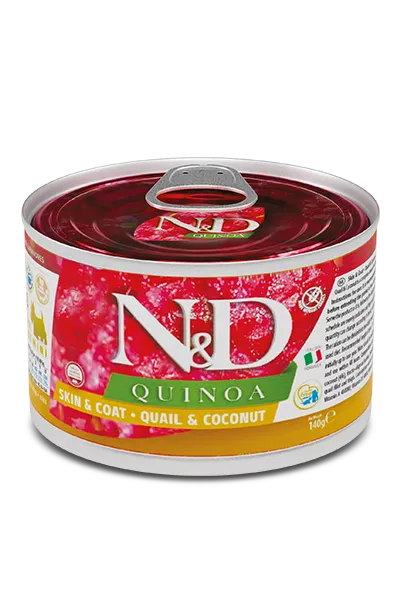
FarminaN&D Quinoa Functional Canine - Skin & Coat Quail mini wet food
Allergy Risk
It's relatively unlikely but possible for allergic reactions to this food's primary ingredients.
Notable Benefits
Ingredients
Numbered in order of predominance by weight, heaviest first. Click any ingredient for details.
N&D Quinoa Functional Canine - Skin & Coat Quail mini wet food ingredients, explained
The recipe is built on quail, the first ingredient on the label. None of the common dog food allergens appear on the label. Omega-3 comes from herring oil, the form dogs use directly.
What this food is made of
Oil pressed from whole fish, usually menhaden, herring or sardine, added as the source of the omega-3 fats EPA and DHA. Those fats support skin, coat, joints and brain development, and a food that names fish oil is delivering them in the form pets use directly. It goes rancid quickly, so look for a preservative named alongside it, usually mixed tocopherols. The species is rarely stated, which matters only if your pet reacts to fish.
A plant fat high in medium-chain triglycerides, fats the body can burn quickly without the usual digestion steps. Those fats are the reason coconut oil appears in some senior and brain-support foods, where small studies of medium-chain fats in older dogs showed modest cognitive benefits; a food's coconut oil is a lower dose of the same fats. It supplies almost no essential fatty acids, so a food cannot rely on it as the only fat. It is calorie-dense and fine in the small amounts used.
Vitamins, minerals and additives (12)
The nutrient pack nearly every complete food carries. Expand to read what each one does.
A calcium source, the same compound as limestone or chalk. Meat is low in calcium and high in phosphorus, so foods add calcium to keep the two in balance, which matters for bone and for large-breed puppies in particular. Routine and safe. Not an allergen.
A potassium source and an electrolyte. Potassium keeps muscles and nerves working, including the heart, and cats lose more of it than dogs do. It also stands in for part of the salt in foods that are formulated lower in sodium. A routine additive with no allergy or safety concern at food levels.
A cartilage component, usually from cattle or chicken cartilage, almost always paired with glucosamine in joint-support foods. The same caveats apply: the evidence in dogs is modest, the dose in a complete food is usually below that used in supplement trials, and the amount on the bag is what to compare. Because it usually comes from chicken or beef cartilage, strict allergy diets may need to check the source.
A building block of cartilage, usually from shellfish shells, added to joint-support and senior foods. The evidence in dogs is mixed: some trials show modest improvement in arthritis signs, others none, and the dose in a food is typically well below the dose used in those trials. No safety issue at food doses. If joint support is the goal, the amount per cup, stated on the bag, is the number to compare; the ingredient's presence alone says little.
Essential for vision, skin and immune function. Cats cannot convert the plant form (beta-carotene) into vitamin A the way dogs can, so cat food must carry the preformed vitamin. It is fat-soluble and stored in the liver, so very high doses over time are harmful, which is why the amount is regulated. Normal on any complete food.
Dogs and cats cannot make useful amounts of vitamin D from sunlight, so it has to be in the food. It governs calcium and bone health. It is also one of the few vitamins where too much is dangerous: excess vitamin D has caused pet food recalls. The amount is regulated and the presence of D3 on a label is expected. What matters is that the maker gets the dose right, which is a quality-control question, not an ingredient question.
A fat-soluble antioxidant that protects cells and the fats in the food itself. It is in nearly every complete food, both as a nutrient and, under the name mixed tocopherols, as the natural preservative that keeps fat from going rancid. Deficiency is rare in pets eating a complete diet. Nothing to worry about on a label, and a sign the maker is preserving with vitamin E rather than synthetic chemicals.
A B-vitamin relative added to nearly every complete food because animals need more than the base ingredients supply. It supports liver function and cell membranes. Seeing it on a label is normal and reassuring rather than a concern.
Yeast grown in a selenium-rich medium so the mineral is bound into the yeast's proteins, which is the form found in meat. Selenium is an essential antioxidant mineral that pets need in tiny amounts and that is toxic in large ones. Selenium yeast is absorbed more steadily than sodium selenite, the inorganic alternative, and is the form many nutritionists prefer. Either form is safe at label levels.
An essential amino acid, added to top up protein quality and, in cat food especially, to acidify urine and discourage the struvite crystals behind some urinary problems. Routine and safe in a complete food. If your cat has a history of the other crystal type (oxalate), urine acidifiers are a vet conversation.
An amino acid cats cannot make in sufficient quantity and must eat, or they develop heart disease and blindness. It is in every complete cat food by law of nutrition, not by choice. Dogs make their own, but it is added to many dog foods as a precaution after a federal investigation into diet-associated heart disease in dogs. Its presence on a dog food label is a good sign, not a warning.
A compound made from amino acids that helps cells burn fat for energy. It is found naturally in meat, and it is added to many weight-control and senior foods on the reasoning that it supports lean body mass during weight loss. The evidence in dogs is modest and the amounts used are safe. Its presence usually signals a food designed for weight management.
About this food
Farmina Pet Foods - dog food - n&d quinoa functional canine - skin & coat quail mini wet food
From the manufacturer. May contain marketing language.
Pricing & Formats
Available Sizes
Not specified
Where to buy
Reader-supported: we may earn a commission when you buy through these links. How we make money
Guaranteed Analysis
Each bar shows the typical range for dog foods in our database. The marker shows where this product falls.
*Not recognized as an essential nutrient by the AAFCO Dog Food Nutrient Profiles.
Similar foods you may like
Based on shared ingredients, features, and customer preferences
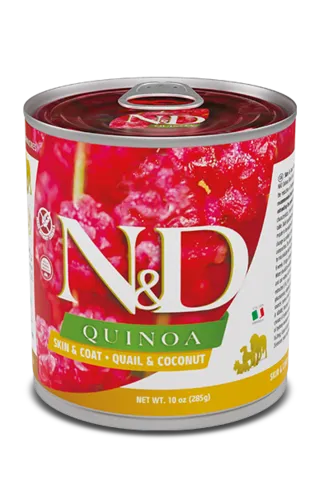
N&D Quinoa Functional Canine - Skin & Coat Quail wet food
Low allergen risk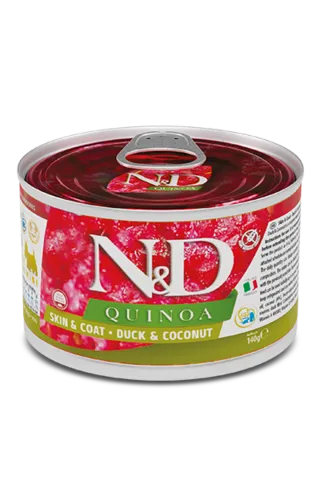
N&D Quinoa Functional Canine - Skin & Coat Duck mini wet food
Low allergen risk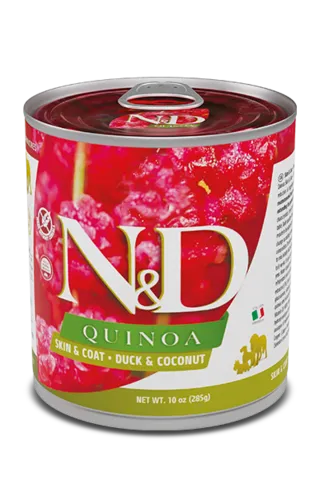
N&D Quinoa Functional Canine - Skin & Coat Duck wet food
Low allergen risk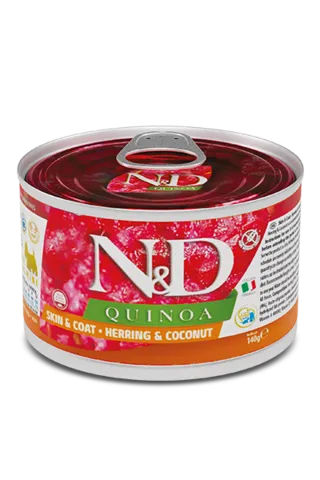
N&D Quinoa Functional Canine - Skin & Coat Herring mini wet food
Medium risk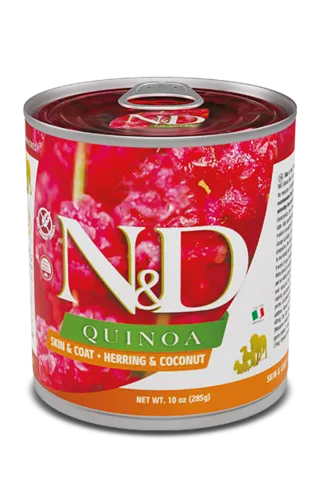
N&D Quinoa Functional Canine - Skin & Coat Herring wet food
Medium riskReview Sources
Our aggregate score is calculated from reviews across multiple retailers
No ratings available