 Made in USA

Hi! I'm CodyBot. I can't answer your questions yet, but I can pass them on to my owner! 🐾
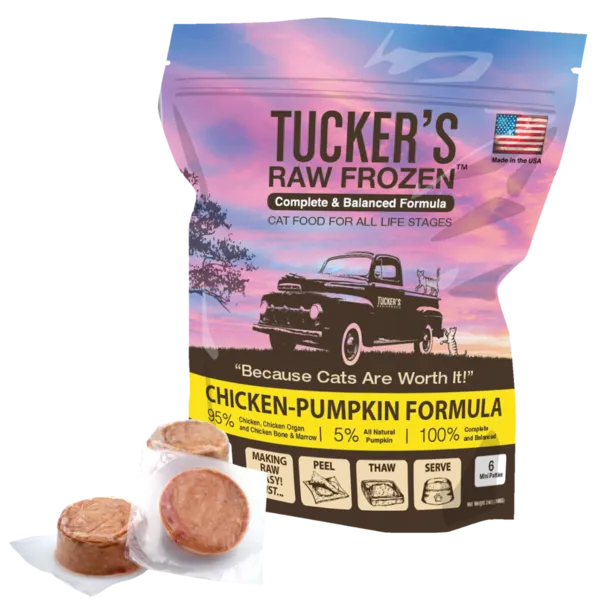
TuckersRaw Cat Food: Chicken & Pumpkin
Allergy Risk
This food contains possible allergens for sensitive pets.
Notable Benefits
Ingredients
Numbered in order of predominance by weight, heaviest first. Click any ingredient for details.
Raw Cat Food: Chicken & Pumpkin ingredients, explained
The recipe is built on chicken: chicken, chicken heart, chicken liver and chicken are four of the first five ingredients. Common cat food allergens on the label: chicken.
What this food is made of
The most common protein in pet food, and for dogs one of the most common food allergens, with beef and dairy. If chicken is what your pet reacts to, it hides everywhere: chicken fat, chicken broth, chicken meal, natural flavor. On a label, chicken listed first is weighed with its water still in, so a food leading with fresh chicken often has less chicken protein than one leading with chicken meal. Neither is better; they are different measures.
Heart muscle from the chicken, a lean organ meat rich in taurine, iron and B vitamins. Raw and fresh-food makers use it as a natural source of the taurine cats require. It adds protein without much fat and appears mostly in fresh, frozen and freeze-dried foods. For an allergic pet it is still chicken.
The liver of the chicken, used both as a nutrient-dense ingredient and as a flavor. It is rich in vitamin A, iron, copper and B vitamins and most pets find it very palatable, which is why it turns up in treats and as a coating on kibble. Because it is chicken, it counts as chicken for a pet with a chicken allergy, even when it appears far down the list.
A vegetable used mainly as a source of soluble fiber for stool quality, and for label appeal. Amounts in a complete food are small. Not an allergen of concern and not a meaningful protein or calorie source.
Vitamins, minerals and additives (16)
The nutrient pack nearly every complete food carries. Expand to read what each one does.
A calcium source, the same compound as limestone or chalk. Meat is low in calcium and high in phosphorus, so foods add calcium to keep the two in balance, which matters for bone and for large-breed puppies in particular. Routine and safe. Not an allergen.
An amino acid cats cannot make in sufficient quantity and must eat, or they develop heart disease and blindness. It is in every complete cat food by law of nutrition, not by choice. Dogs make their own, but it is added to many dog foods as a precaution after a federal investigation into diet-associated heart disease in dogs. Its presence on a dog food label is a good sign, not a warning.
A B-vitamin relative added to nearly every complete food because animals need more than the base ingredients supply. It supports liver function and cell membranes. Seeing it on a label is normal and reassuring rather than a concern.
A fat-soluble antioxidant that protects cells and the fats in the food itself. It is in nearly every complete food, both as a nutrient and, under the name mixed tocopherols, as the natural preservative that keeps fat from going rancid. Deficiency is rare in pets eating a complete diet. Nothing to worry about on a label, and a sign the maker is preserving with vitamin E rather than synthetic chemicals.
A zinc source. Zinc is essential for skin, coat, immunity and wound healing, and deficiency shows up first as crusty skin. Some Arctic breeds absorb it poorly and need more. Sulfate and oxide are inorganic; proteinate or chelate is bound to protein, which brands present as better absorbed. Any of them is normal. Not an allergen.
Vitamin B3. Dogs can make some from the amino acid tryptophan; cats cannot make enough and must get it from food, which is one of many reasons cat food and dog food are not interchangeable. Water-soluble and safe at food levels. Expected on every complete food label.
A manganese source. Manganese is needed in tiny amounts for bone, cartilage and enzyme function. Sulfate is the inorganic form; proteinate is the mineral bound to protein. The choice between them is a marketing distinction more than a health one for a healthy pet. Expected, safe, not an allergen.
Essential for vision, skin and immune function. Cats cannot convert the plant form (beta-carotene) into vitamin A the way dogs can, so cat food must carry the preformed vitamin. It is fat-soluble and stored in the liver, so very high doses over time are harmful, which is why the amount is regulated. Normal on any complete food.
A B vitamin tied to skin and coat quality and to fat and protein metabolism. Gut bacteria make some; food supplies the rest. Raw egg white contains a protein that binds biotin, which is the reason raw-egg diets can cause a deficiency. Safe, expected, and not an allergen.
Vitamin B5 in its stable added form (the d- prefix just names the active version). It is needed to turn fats and carbohydrates into energy. Widely available in meats and grains, topped up to guarantee the level. Safe, expected, and irrelevant to allergies.
Vitamin B2, used to turn food into energy. Present in meat and dairy but partly lost in cooking, so manufacturers top it up. Water-soluble and safe at the levels used in food. Its presence tells you the food was formulated to a complete nutrient profile, not that anything unusual is going on.
Vitamin B6 in its stable, added form. It is central to protein metabolism, and cats need proportionally more of it than dogs because their diet runs so high in protein. Water-soluble and safe at food levels. A normal line on any complete food.
Needed for nerve function and making red blood cells. It occurs naturally only in animal tissue, so it is added to almost every food to guarantee the level. Water-soluble, so excess passes out in urine. Cats and dogs with chronic gut disease can run low even on a good diet, which is a vet conversation rather than a food choice.
Dogs and cats cannot make useful amounts of vitamin D from sunlight, so it has to be in the food. It governs calcium and bone health. It is also one of the few vitamins where too much is dangerous: excess vitamin D has caused pet food recalls. The amount is regulated and the presence of D3 on a label is expected. What matters is that the maker gets the dose right, which is a quality-control question, not an ingredient question.
An iodine source. Iodine runs the thyroid, and pets cannot get enough without it being added. Calcium iodate and potassium iodide are the common forms and do the same job. Whether dietary iodine plays a role in the overactive thyroid common in older cats has been studied without a clear answer. A normal line on any complete food.
Vitamin B9, needed for cell division and healthy blood. Standard fortification in complete foods for dogs and cats. Water-soluble, no toxicity concern at food levels. Its main relevance to a shopper is none: it is there because the recipe was balanced properly.
About this food
Tucker's complete and balanced Chicken-Pumpkin Formula offers a convenient raw food diet for cats. Made in the USA.
From the manufacturer. May contain marketing language.
Pricing & Formats
Available Sizes
Not specified
Where to buy
Reader-supported: we may earn a commission when you buy through these links. How we make money
Guaranteed Analysis
Each bar shows the typical range for cat foods in our database. The marker shows where this product falls.
*Not recognized as an essential nutrient by the AAFCO Dog Food Nutrient Profiles.
Similar foods you may like
Based on shared ingredients, features, and customer preferences

Raw Boost Kibble Healthy Weight Recipe
Medium risk
Raw Boost Kibble Indoor Health Recipe with Real Chicken
Medium risk
Limited Ingredient Diet Chicken Paté Wet Cat Food
Medium risk
Raw Boost Kibble Real Chicken Recipe
Medium risk
Chunks & Shreds, Chicken & Tuna Recipe for Kittens Dog & Cat Food
High riskReview Sources
Our aggregate score is calculated from reviews across multiple retailers
No ratings available