 Made in USA

Hi! I'm CodyBot. I can't answer your questions yet, but I can pass them on to my owner! 🐾
SojosComplete Senior Food Turkey & Salmon Recipe
Allergy Risk
This food contains possible allergens for sensitive pets.
Notable Benefits
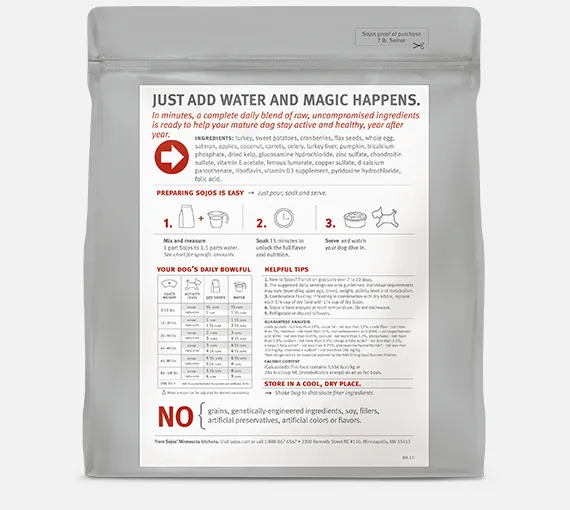
Ingredients
Numbered in order of predominance by weight, heaviest first. Click any ingredient for details.
Complete Senior Food Turkey & Salmon Recipe ingredients, explained
The recipe is built on salmon, listed sixth on the label. Common dog food allergens on the label: salmon and egg. The only omega-3 source is flaxseed, which dogs convert to the useful forms inefficiently.
What this food is made of
A poultry protein, similar to chicken in nutrition and usually a little leaner. Fresh or deboned turkey is mostly water and ranks higher on the label than its dry contribution; turkey meal is the concentrated form. Turkey is often used as an alternative for pets that react to chicken, but the two are related birds and some pets react to both, so it is not a guaranteed swap.
A root vegetable used as a carbohydrate source, especially in grain-free foods. It supplies energy, fiber and beta carotene and is well digested by dogs. There is no good evidence it beats rice or oats nutritionally, though it is a reasonable choice for pets that do poorly on grains. Like any starch, a food that lists it high is a starch-heavy food.
A small fruit added mostly for its association with urinary health. Cranberry compounds can make it harder for some bacteria to cling to the bladder wall in laboratory studies, but there is no good evidence that the amount in a pet food prevents or treats urinary infections. At label levels, a small amount well down the list, treat it as a minor fruit that adds a little fiber and antioxidants.
A plant source of omega-3 fat (alpha-linolenic acid) and fiber, used in about a third of dog foods for coat and stool quality. Dogs and cats convert plant omega-3 to the useful forms inefficiently, so fish oil does the job better. Flax is not a documented common allergen, though some pets tolerate it poorly, most often as loose stool. Fine in a food; not a reason to prefer it over one using fish oil.
A complete, highly digestible protein, which is why formulators like it. It is also a documented allergen in about 4% of dogs with food reactions. Egg allergy does not implicate chicken meat; the proteins are different. Dried egg product is the same thing with the water removed. A good ingredient for most pets and a fine-print one for the allergic few.
A fatty fish used as a protein source and as a natural source of omega-3 fats. Fresh salmon is mostly water, so a salmon meal lower on the list may be contributing more protein. Salmon is a common alternative protein for pets that react to chicken or beef, though fish allergies exist too. Farmed and wild salmon differ in fat profile, and labels rarely say which.
A fruit added for fiber, a little natural sweetness and antioxidants. Apple flesh is safe for dogs and cats. The seeds contain a trace of a cyanide-forming compound, which matters for a dog eating whole apples and is far below any concern at the amounts of pomace or dried apple in a food. Apple pomace is what remains after juicing and is mostly fiber. In either form it appears in small amounts and does not change the nutrition of the food in a meaningful way.
A plant fat high in medium-chain triglycerides, fats the body can burn quickly without the usual digestion steps. Those fats are the reason coconut oil appears in some senior and brain-support foods, where small studies of medium-chain fats in older dogs showed modest cognitive benefits; a food's coconut oil is a lower dose of the same fats. It supplies almost no essential fatty acids, so a food cannot rely on it as the only fat. It is calorie-dense and fine in the small amounts used.
A vegetable that contributes a little fiber and beta-carotene and a lot of label appeal. In dry food it is usually present in small amounts well down the list. It is not an allergen of concern and not a meaningful protein or calorie source. Fine to see; not a reason to choose one food over another.
A vegetable added in small amounts for fiber and a little flavor, and in fresh or raw recipes for its water content. It is safe for dogs and cats and appears well down the list, often alongside other vegetables in a blend. It brings almost no calories and only trace nutrients at these levels, so it changes nothing about the food either way.
Organ meat from the named animal, or unnamed when the label just says liver. Liver is one of the most nutrient-dense foods there is, rich in vitamin A, copper, iron and the B group, and most pets love the taste, which is why it is used both as an ingredient and as a flavor coating. For allergies, the species is what matters, and beef liver is beef. Unnamed liver can come from any species and may vary by batch.
A vegetable used mainly as a source of soluble fiber for stool quality, and for label appeal. Amounts in a complete food are small. Not an allergen of concern and not a meaningful protein or calorie source.
Vitamins, minerals and additives (2)
The nutrient pack nearly every complete food carries. Expand to read what each one does.
A calcium and phosphorus source that also keeps dry food from clumping. Both minerals are essential and their ratio matters for bone health. Routine and safe. For cats with kidney disease, phosphorus level is the number to watch, and the source is less important than the total.
A dried seaweed added as a natural source of iodine and trace minerals. Iodine is needed for thyroid function, and kelp is one of the few whole-food sources of it. The iodine content of kelp varies a great deal between harvests, so it has to be tested and dosed carefully, and the label will not tell you whether it was. Pets with thyroid disease should get the vet's view on foods that use kelp as the main iodine source.
About this food
PVK2wmBoIZ6D--W76-Aw3oZRKQBfG9MMMNuWUPk0vRU
From the manufacturer. May contain marketing language.
Pricing & Formats
Available Sizes
Price History (7 lb)
Where to buy (7 lb)
Reader-supported: we may earn a commission when you buy through these links. How we make money
Guaranteed Analysis
Each bar shows the typical range for dog foods in our database. The marker shows where this product falls.
*Not recognized as an essential nutrient by the AAFCO Dog Food Nutrient Profiles.
Similar foods you may like
Based on shared ingredients, features, and customer preferences
Complete Dog Food Turkey Recipe
Medium risk
Four-Star Nutritionals Game Bird Recipe Dog Food
Medium risk
Grain Free Turkey Whole Food Clusters
Medium risk. Wild Caught Salmon - Gentle Giants 'Quality of Life' Feast for
Medium risk
Four-Star Nutritionals Salmon À La Veg Food for Dogs
High riskReview Sources
Our aggregate score is calculated from reviews across multiple retailers