 Made in USA

Hi! I'm CodyBot. I can't answer your questions yet, but I can pass them on to my owner! 🐾
FrommPurrSnackitty™ Soft & Savory Salmon Flavor Treats
Allergy Risk
This food contains possible allergens for sensitive pets.
Notable Benefits
Ingredients
Numbered in order of predominance by weight, heaviest first. Click any ingredient for details.
PurrSnackitty™ Soft & Savory Salmon Flavor Treats ingredients, explained
The recipe is built on salmon, the first ingredient on the label. Common cat food allergens on the label: salmon.
What this food is made of
A fatty fish used as a protein source and as a natural source of omega-3 fats. Fresh salmon is mostly water, so a salmon meal lower on the list may be contributing more protein. Salmon is a common alternative protein for pets that react to chicken or beef, though fish allergies exist too. Farmed and wild salmon differ in fat profile, and labels rarely say which.
A legume used as a carbohydrate and plant protein, common in grain-free foods. Chickpeas supply fiber, folate and protein that lifts the number on the bag without adding meat. Legume-heavy grain-free foods were part of the FDA's 2018 to 2022 look at diet-associated heart disease in dogs, which did not establish a cause. A food that lists chickpeas or peas in the first few ingredients is leaning on plant protein.
A staple of grain-free recipes, supplying starch, fiber and plant protein. Peas were common in the diets examined in a federal investigation into heart disease in dogs; the investigation did not establish a cause and no ingredient was banned. Pea protein high on a list can inflate the protein number with a plant source. Pea allergy is rare. Not a problem, but worth noticing when it appears in several forms in one recipe.
Starch from the cassava root, used to bind kibble and as a carbohydrate source, especially in grain-free foods. It is nearly pure starch with little protein, fiber or micronutrients, and it is one of the least likely ingredients to trigger an allergy. A food that leans on tapioca for carbohydrate is getting easy digestibility and little else from it, which is fine as long as the rest of the recipe carries the nutrition.
A plant fat high in medium-chain triglycerides, fats the body can burn quickly without the usual digestion steps. Those fats are the reason coconut oil appears in some senior and brain-support foods, where small studies of medium-chain fats in older dogs showed modest cognitive benefits; a food's coconut oil is a lower dose of the same fats. It supplies almost no essential fatty acids, so a food cannot rely on it as the only fat. It is calorie-dense and fine in the small amounts used.
A root vegetable used as a carbohydrate source, especially in grain-free foods. It supplies energy, fiber and beta carotene and is well digested by dogs. There is no good evidence it beats rice or oats nutritionally, though it is a reasonable choice for pets that do poorly on grains. Like any starch, a food that lists it high is a starch-heavy food.
The familiar white potato, used as a carbohydrate source in many grain-free foods. Potato starch binds kibble; potato protein is a concentrated plant protein that lifts the protein figure on the bag. Cooked potato is safe and well digested. Grain-free foods built on potatoes and legumes were part of the FDA's 2018 to 2022 look at diet-associated heart disease in dogs, which did not establish a cause; the agency has not asked for any to be withdrawn.
Vitamins, minerals and additives (2)
The nutrient pack nearly every complete food carries. Expand to read what each one does.
Sodium and chloride, both essential, plus a palatability boost. Pets need less than people, and the minimum is set in the nutrient profiles the food is formulated to. Salt high on the list of a treat is a flavor choice; salt near the end of a complete food is nutrition. Ask your vet before choosing a low-sodium food for heart or kidney disease rather than reading labels alone.
An amino acid cats cannot make in sufficient quantity and must eat, or they develop heart disease and blindness. It is in every complete cat food by law of nutrition, not by choice. Dogs make their own, but it is added to many dog foods as a precaution after a federal investigation into diet-associated heart disease in dogs. Its presence on a dog food label is a good sign, not a warning.
About this food
PurrSnackitty™ Soft & Savory Salmon Flavor Treats
From the manufacturer. May contain marketing language.
Pricing & Formats
Available Sizes
Price History (3 oz)
Where to buy (3 oz)
Reader-supported: we may earn a commission when you buy through these links. How we make money
Guaranteed Analysis
Each bar shows the typical range for cat foods in our database. The marker shows where this product falls.
*Not recognized as an essential nutrient by the AAFCO Dog Food Nutrient Profiles.
Similar foods you may like
Based on shared ingredients, features, and customer preferences

PurrSnackitty™ Soft & Savory Chicken Flavor Treats
Medium risk
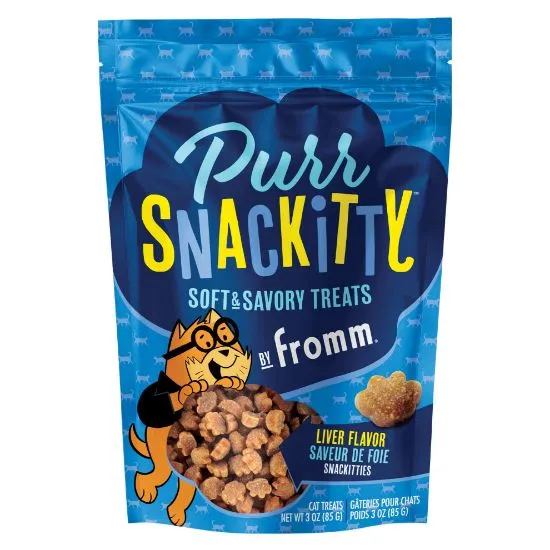
PurrSnackitty™ Soft & Savory Liver Flavor Treats
Medium risk
Soft & Chewy Mini Treats: Tuna & Salmon Flavor
High risk
Chicken Soft & Chewy
Medium risk
Chicken Soft & Chewy
Medium riskReview Sources
Our aggregate score is calculated from reviews across multiple retailers
No ratings available