
Hi! I'm CodyBot. I can't answer your questions yet, but I can pass them on to my owner! 🐾
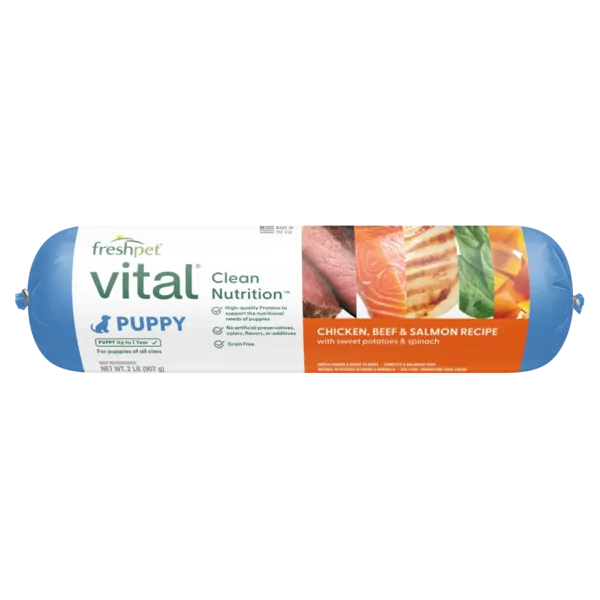
FreshpetVital Puppy: Chicken, Beef & Salmon Recipe with Sweet Potatoes & Spinach
Allergy Risk
This food contains possible allergens for sensitive pets.
Notable Benefits
Ingredients
Numbered in order of predominance by weight, heaviest first. Click any ingredient for details.
Vital Puppy: Chicken, Beef & Salmon Recipe with Sweet Potatoes & Spinach ingredients, explained
The recipe is built on beef, listed second on the label. Common dog food allergens on the label: beef, chicken, salmon and egg.
What this food is made of
The most common protein in pet food, and for dogs one of the most common food allergens, with beef and dairy. If chicken is what your pet reacts to, it hides everywhere: chicken fat, chicken broth, chicken meal, natural flavor. On a label, chicken listed first is weighed with its water still in, so a food leading with fresh chicken often has less chicken protein than one leading with chicken meal. Neither is better; they are different measures.
A red-meat protein, higher in fat and iron than poultry. Fresh or deboned beef is mostly water and ranks higher on the label than its dry contribution; beef meal is the concentrated form. Beef is among the most common food allergens reported in both dogs and cats, probably because it has been fed so widely for so long. Beef by-products such as liver and heart are listed separately.
A complete, highly digestible protein, which is why formulators like it. It is also a documented allergen in about 4% of dogs with food reactions. Egg allergy does not implicate chicken meat; the proteins are different. Dried egg product is the same thing with the water removed. A good ingredient for most pets and a fine-print one for the allergic few.
The liver of the chicken, used both as a nutrient-dense ingredient and as a flavor. It is rich in vitamin A, iron, copper and B vitamins and most pets find it very palatable, which is why it turns up in treats and as a coating on kibble. Because it is chicken, it counts as chicken for a pet with a chicken allergy, even when it appears far down the list.
A fatty fish used as a protein source and as a natural source of omega-3 fats. Fresh salmon is mostly water, so a salmon meal lower on the list may be contributing more protein. Salmon is a common alternative protein for pets that react to chicken or beef, though fish allergies exist too. Farmed and wild salmon differ in fat profile, and labels rarely say which.
A root vegetable used as a carbohydrate source, especially in grain-free foods. It supplies energy, fiber and beta carotene and is well digested by dogs. There is no good evidence it beats rice or oats nutritionally, though it is a reasonable choice for pets that do poorly on grains. Like any starch, a food that lists it high is a starch-heavy food.
A leafy green added in small amounts for vitamins, minerals and color. Spinach is high in oxalate, which binds calcium and in large quantities is a concern for pets prone to calcium oxalate bladder stones. The amounts in a complete food are tiny, often a fraction of a percent, so for most pets it is a token vegetable with no nutritional or safety weight.
A vegetable used mainly as a source of soluble fiber for stool quality, and for label appeal. Amounts in a complete food are small. Not an allergen of concern and not a meaningful protein or calorie source.
A vegetable added in small amounts for fiber and a little flavor, and in fresh or raw recipes for its water content. It is safe for dogs and cats and appears well down the list, often alongside other vegetables in a blend. It brings almost no calories and only trace nutrients at these levels, so it changes nothing about the food either way.
Vitamins, minerals and additives (2)
The nutrient pack nearly every complete food carries. Expand to read what each one does.
A thickener extracted from red seaweed, used to give wet foods a firm loaf or smooth gravy. It is the most debated pet-food gum: some lab studies linked a degraded form to gut inflammation in rodents, and food-grade carrageenan is a different substance that has not shown the same effect, though the question stays open. Regulators in the US and EU allow it. A pet with chronic gut trouble is a reasonable case for trying a food without it.
A B-vitamin relative added to nearly every complete food because animals need more than the base ingredients supply. It supports liver function and cell membranes. Seeing it on a label is normal and reassuring rather than a concern.
About this food
For growing pups, fresh proteins, Omega-3s, and DHA support healthy development from head to tail.
From the manufacturer. May contain marketing language.
Pricing & Formats
Available Sizes
Price History (1.75 lb)
Where to buy (1.75 lb)
Reader-supported: we may earn a commission when you buy through these links. How we make money
Guaranteed Analysis
Each bar shows the typical range for dog foods in our database. The marker shows where this product falls.
*Not recognized as an essential nutrient by the AAFCO Dog Food Nutrient Profiles.
Similar foods you may like
Based on shared ingredients, features, and customer preferences
Vital Grain Free Chicken, Beef, Salmon & Egg Recipe with Cranberries, Blueberries & Spinach
Medium risk
Vital Small Breed: Chicken, Beef, Egg & Salmon Recipe with Sweet Potatoes & Spinach
Medium risk
Vital Healthy Aging: Chicken & Salmon Recipe with Cranberries, Sweet Potatoes, & Carrots
Medium risk
Multi-Protein Chicken, Beef and Salmon Dog Food Roll
Medium risk
Nature’s Fresh Chicken, Carrots, Peas & Spinach Dog Food
Medium riskReview Sources
Our aggregate score is calculated from reviews across multiple retailers